- Published: 08.04.2026.
Question Time: Minister Habijan on progress in judiciary and record drop in court backlog
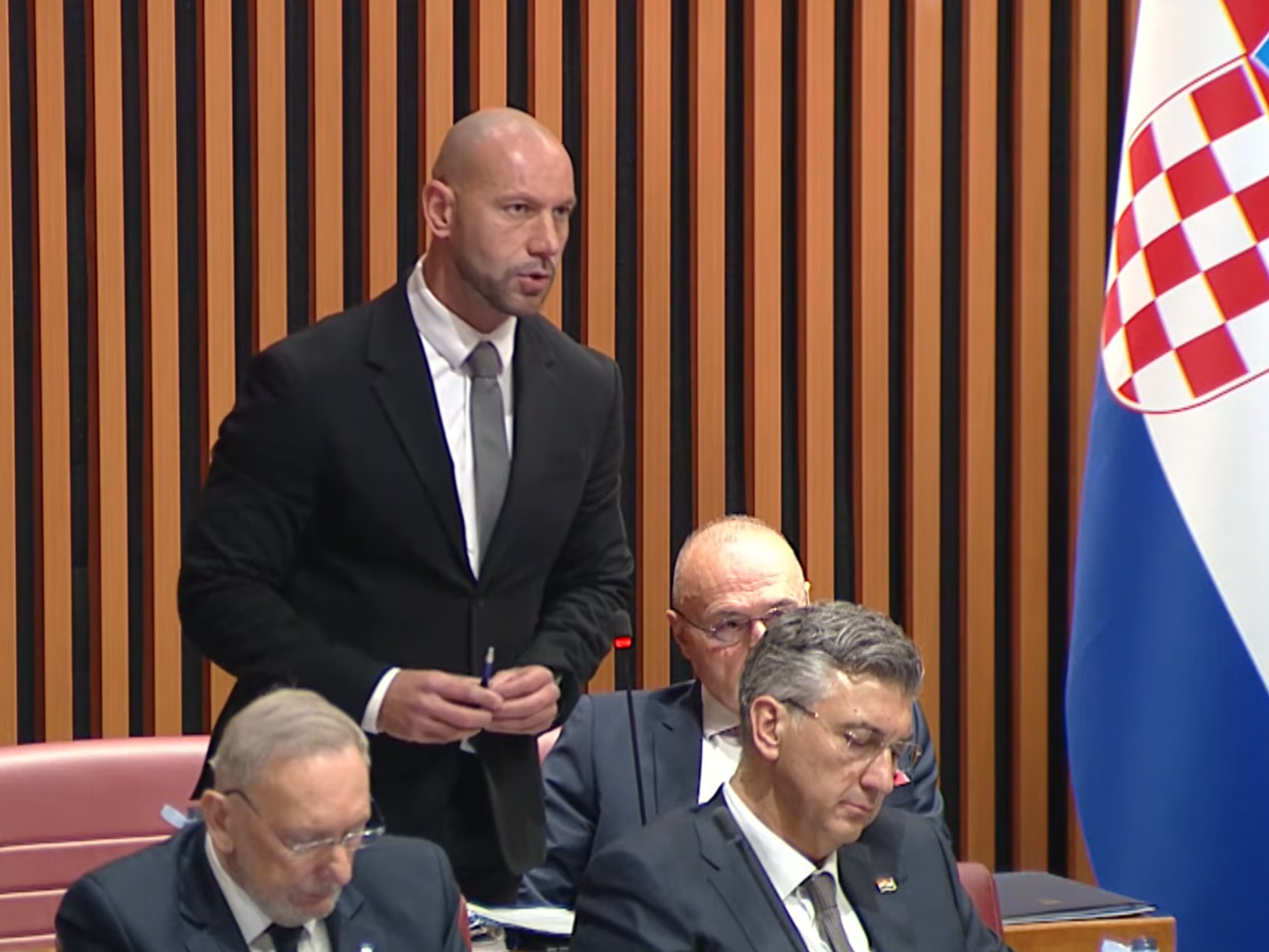
During Question Time at the beginning of the 10th session of the Croatian Parliament, Minister of Justice, Public Administration and Digital Transformation Damir Habijan answered two parliamentary questions, on the situation in the judiciary and the Act on the Protection of Persons Who Engage in Public Participation
Shorter proceedings and falling backlogSpeaking about the election of the president of the Supreme Court and three remaining judges of the Constitutional Court, the minister recalled that the parliamentary majority had already proposed a solution to fill these positions.
‘As far as the situation in the judiciary is concerned, I will reiterate the figures that I am constantly pointing out. If we compare today to 2020, the average length of court proceedings in civil and commercial cases was 650 days, while today it is 480 days. In criminal cases, the average length of proceedings is 116 days’, said Minister Habijan.
In relation to pending cases in courts, there were 475,000 in 2020, compared to 384,000 at the moment.
Minister Habijan stressed that this is the first time that the number of pending cases in courts has fallen below 400,000.
‘As Minister of Justice, Public Administration and Digital Transformation, I will not allow generalisation and negative portrayal of justice. Just read the European Commission’s 2025 Rule of Law Report and the developments noted by the Commission. The Report outlines legislative activities, including amendments to the Criminal Procedure Act, the Criminal Code, the Act on the Protection of Persons Who Report Irregularities and the adoption of the Lobbying Act, and soon the Act on the Protection of Persons Who Engage in Public Participation from manifestly unfounded claims will be presented in the Croatian Parliament. This is all the work of the Ministry and the Government on the issue of justice’, the Minister said.
The new law to protect not only journalists, but also whistleblowers, trade unionists and publishers
The second parliamentary question concerned the Act on the Protection of Persons Persons Who Engage in Public Participation from manifestly unfounded claims.
It is important to point out that the Act will apply not only to journalists, who are the most prominent, but also to publishers, media organsations, whistle-blowers, trade unionists and all other groups of persons who engage in public participation and may be exposed to manifestly unfounded claims, and in this way they will be afforded greater legal protection.
Minister Habijan thanked Minister of Culture and Media Nina Obuljen Koržinek for cooperation during the drafting of the Act, noting that during this period several round tables were organised with the aim of promoting this topic in the media and the public.
‘As regards the Act on the Protection of Persons Who Engage in Public Participation, which will soon be presented to the Croatian public, there are four crucial things when it comes to the protection of those persons, the so-called procedural safeguards in terms of: security to cover the estimated costs of the proceedings, early dismissal of manifestly unfounded claims, which will require further training of judicial officials to be able to recognise SLAPP cases, thirdly, the reimbursement of procedural costs, and fourthly, fines and other penalties’, explained Minister Habijan.
In the context of this Act, the issue of recognition of SLAPPs is also important. So far there has been talk in the Croatian public of almost 900 to 1,000 cases against journalists in Croatia, while an analysis of the Ministry of Justice, Public Administration and Digital Transformation has found that, in 2024, there were 25 active cases of (civil) claims for damages and 7 active criminal cases that could constitute SLAPPs.
‘As regards the scope of the Act itself, it will cover civil proceedings, while criminal proceedings will continue to be covered by the Criminal Code’, Minister Habijan concluded.