- Published: 03.05.2026.
Minister Habijan for Večernji list: We are working on a comprehensive legal solution to make online space as safe as possible for children
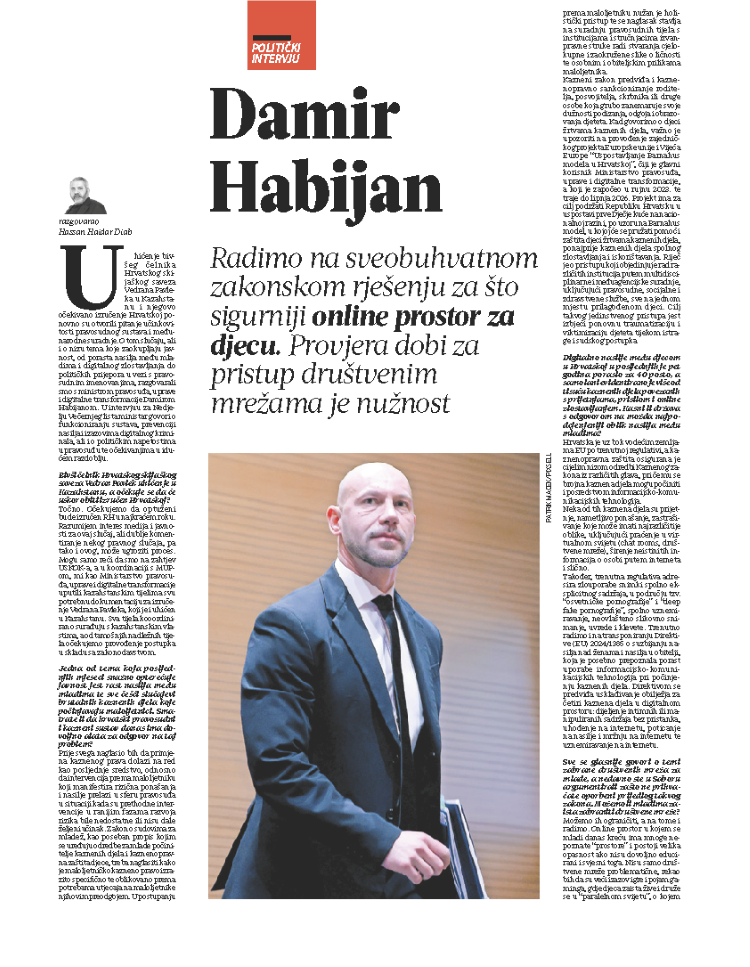
In an interview for the Sunday special magazine supplement of the Večernji list, the Minister talks about the functioning of the system, the prevention of violence and the challenges of digital crime, as well as political tensions concerning the judiciary and expectations in the coming period
The arrest of former head of Croatian Ski Association Vedran Pavlek in Kazakhstan and his expected extradition to Croatia have re-opened the issue of the efficiency of the judicial system and international cooperation.The Večernji list spoke with Minister of Justice, Public Administration and Digital Transformation Damir Habijan about this case as well as a number of topics that concern the public, from the rise of youth violence and digital abuse to political controversies regarding judicial appointments.
Former head of the Croatian Ski Association Vedran Pavlek has been arrested in Kazakhstan and is expected to be extradited to Croatia soon?
That's right. We expect the accused to be promptly extradited to Croatia. I understand the interest of the media and the public in this case, but a deeper comment on a legal case, including this one, could undermine the process. I can only say that, at the request of USKOK, and in coordination with the Ministry of the Interior, the Ministry of Justice, Public Administration and Digital Transformation sent to the Kazakh authorities all the necessary documentation for the extradition of Vedran Pavlek, who had been arrested in Kazakhstan. All our authorities are cooperating in a coordinated manner with the Kazakh authorities, and we expect the authorities there to carry out the procedure in accordance with the legislation.
One of the topics heavily burdening the public in recent months is the increase in violence among young people and the increasing incidence of brutal crimes committed by minors. Do you think that the current Croatian judicial and criminal justice system has enough tools to address this problem?
First of all, I would emphasize that the application of criminal law is the last resort, that is, that the intervention towards a minor who manifests risky behaviour and violence moves into the sphere of justice in a situation where previous interventions at earlier stages of risk development were insufficient or did not give the desired effect. The Juvenile Courts Act as a special law governs young offenders and protection of children in criminal justice, and it should be emphasized that juvenile criminal law is extremely specific and formulated according to the needs for influencing minors through re-education.
In the treatment of a minor, a holistic approach is necessary and emphasis is placed on the cooperation of judicial authorities with institutions and experts outside the legal profession in order to create a comprehensive and complete picture of the personality as well as personal and family circumstances of the minor. The Criminal Code also provides for the criminal sanctioning of parents, adoptive parents, guardians or other persons who grossly neglect their duties of raising and educating a child.
When it comes to child victims of crime, it is important to draw attention to the implementation of a joint project of the European Union and the Council of Europe, “Implementing the Barnahus model in Croatia”, the main beneficiary of which is the Ministry of Justice, Public Administration and Digital Transformation, which started in September 2023 and runs until June 2026. The project aims to support Croatia in establishing the first Children's House at the national level modeled on the Barnahus model, which will provide support and protection to child victims of crime, primarily of sexual abuse and exploitation. It is an approach that brings together the work of different institutions through multidisciplinary and inter-agency cooperation, including judicial, social welfare and health services, all in a single child-friendly place. The aim of such a unified approach is to avoid the re-traumatisation and re-victimisation of a child during investigation and judicial proceedings.
Digital violence among children in Croatia has increased by 40 percent in the last five years, and last year alone more than a thousand crimes related to threats, coercion and online abuse were recorded. Is the government late in responding to perhaps the most undervalued form of violence among young people?
Croatia is among the leading EU countries when it comes to current regulations, and criminal justice protection is guaranteed by a number of provisions of the Criminal Code in different titles, whereby numerous criminal offences include commission through information and communication technologies. Some of these criminal offences are threats, intrusive behavior, intimidation that can take a wide variety of forms, including stalking in the virtual world (chat rooms, social media), dissemination of false information about a person over the Internet, et cetera. Moreover, the current law addresses the abuse of images of sexually explicit content, or the so-called “revenge pornography” and “deep fake pornography”, sexual harassment, unauthorised video recording, insults and defamation.
We are also currently working on the transposition of Directive (EU) 2024/1385 on combating violence against women and domestic violence, which has in particular recognised the increase in the use of information and communication technologies in the commission of criminal offences. The Directive provides for the harmonisation of the characteristics of four offences in the digital space: non-consensual sharing of intimate or manipulated material, cyber stalking, cyber incitement to violence and hatred and cyber harassment.
There is an increasing debate on the topic of banning social media for young people, and recently in Parliament you argued why you do not accept the opposition proposal of such a law. Can we really ban social media for young people?
We can limit them, and that's what we are working on. The online space in which young people move today has many unknown “spaces” and there is great danger if they are not sufficiently educated and aware of this. It is not just social media that are problematic, I would say that gaming and the concept of gaming represent a bigger challenge, where children literally live and socialise in a “parallel world”, of which adults know little or nothing. The basis is to educate all users as well as parents about the fact that sex offenders, criminals and many others who do not have good intentions can hide behind a profile.
At the EU level, we have been talking for some time now and are looking for a way to make the online space safe for children. The Jutland Declaration is just one of the documents that Croatia has supported to this end, but I agree that as a society we need to do more. As a society we are responsible for the future of children, but also for the environment in which they develop as persons. Many stakeholders are key to proper development, and I would say that in addition to educational institutions and regulations, it is the family that plays a key role in this. To return to the restriction of social media, the development of a complete technical solution has been underway for some time now, as well as the drafting of a comprehensive law that will address all the necessary topics for the protection of young people in the online world.
What is crucial in all this is that companies that own social networks and other platforms accept the implementation of the technical solution of age verification, and this is exactly what I discussed with a representative of Meta on the sidelines of the Three Seas Initiative Summit. For example, to open a Facebook or Instagram profile, you have to click that you are over 15 or 16 years old - depending on the country you are in, and with the technical solution, the platform would ask you to login to, for example, mCitizens or the EUwallet, which is currently in the process of being created, and age data would be verified in your documents, all in accordance with the GDPR. In other words, the space for lying about age would be narrowed down. It is important to point out that parents already have the ability to restrict various content and applications for their children through platforms such as Android, Google Play and Apple Store, and if a parent sets a ban, the child cannot use that content.
Is the stalemate over the election of three constitutional judges and the president of the Supreme Court the biggest judicial crisis since you have been at the head of the Ministry of Justice and is there a way out?
I would not use the term judicial crisis at this point - there are always challenges in this department. However, I do not think it is good that we have unfilled seats in the highest judicial bodies such as the Supreme Court and the Constitutional Court. That was precisely why we proposed to fill all these seats, aware that an agreement must be reached, because the judges are elected by a two-thirds majority in Parliament. We have opened discussions, and now it is quite clear that the SDP does not want constitutional judges to be elected.
Will the ruling majority stick firmly to the three candidates it has nominated, Željko Pajalić, Mladen Sučević and Goran Selanec, or is it willing to make further compromises? The Constitutional Court has been operating in an incomplete composition for months. How damaging is this for the state?
The HDZ and the ruling coalition have shown seriousness and maturity, and we have nominated the candidates for the Constitutional Court at the Justice Committee and supported all three candidates. The candidates we have nominated meet all the necessary requirements - they are highly professional, with built legal careers behind them, and one of them already serves as a constitutional judge. However, the SDP walked out of the Committee meeting and the plenary session. This shows that the opposition has no concrete arguments which would call into question any of the proposed names, and therefore actually calls into question the consistency of its own political views. This approach gives the impression that filling the seats in the Constitutional Court is not a priority for them, which is not a good message and indicates certain political immaturity.
The opposition claims that by packaging the election of constitutional judges with that of the Supreme Court president, the HDZ is blackmailing political opponents. Has the judiciary in Croatia today become a hostage to parliamentary agreements and party blackmail?
We need to make clear who is using blackmail. It is completely clear now that the SDP and its junior partner Možemo are the ones using blackmail and not caring about the judiciary, but using this situation to collect political points. It is not the first time that the SDP has fled responsibility, as they are doing now, and it is good for the Croatian public to see who the people aspiring to govern this country really are, and how they behave in challenging situations. We now see they are not fit to handle them. Unfortunately, the opposition has taken the citizens of Croatia hostage and has no intention of being constructive in crucial issues for the judicial system, or any other processes in the country for that matter.
Mirta Matić is deemed the principal candidate for the President of the Supreme Court, but first she must be nominated by President Zoran Milanović. Can it happen that this issue is resolved and that the matter of constitutional judges hits the wall again?
I expect the President to respect the procedure this time, and the MPs to finally vote on it.
If the Parliament does not select the key people of the judiciary in May either, will Croatia enter an institutional blockade?
It is difficult for me to say what is going to happen, but I want to believe that the SDP and the opposition will gather courage, demonstrate a basic dose of political maturity and prove that it matters to them that the Supreme Court and the Constitutional Court are in full composition. This is an opportunity for them to prove that they really care about the justice system.
Interviewer: Hassan Haidar Diab
Večernji list, 3 May 2026