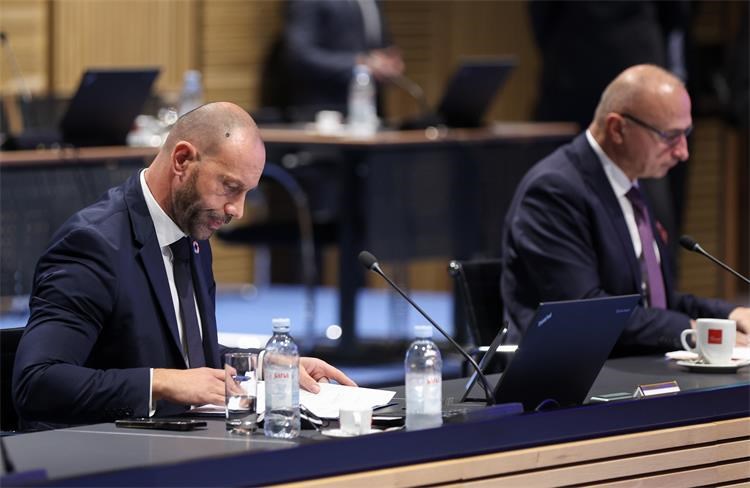
Minister Habijan presented to the Government a Draft Proposal of the Act on Judicial Cooperation in Criminal Matters with EU Member States, to achieve full compliance with the European legal order
Full alignment with the EU acquis
‘Since the current law has been amended eight times, a completely new and comprehensive text has been drafted. The new legislative proposal ensures that the relevant instruments of the European Union in the field of judicial cooperation in criminal matters are fully taken up and implemented, thus bringing the domestic legal order into line with European legislation on an ongoing basis’, said the Minister.
The draft law also incorporates implementing provisions allowing for the full application of the Regulation of the European Parliament and of the Council on the transfer of proceedings in criminal matters. The Regulation was adopted in November 2024 and will apply from 1 February 2027 among the Member States that participated in its adoption.
Report on the number of voters per constituency
The Government accepted and sent to the Croatian Parliament the Report on the number of voters registered in the Electoral Register and the number of voters per constituency for the first quarter of 2026.
The Act on Constituencies for the Election of Members to the Croatian Parliament stipulates that the size of the electorate per constituency must not differ by more than 5 percent from the basis. The report determined the sizes of the electorate in relation to the legal basis based on the collected data for the first quarter.
Significant increase in the number of cases before the Civil Service Board
Furthermore, a Report on the activities of the Civil Service Board for the period from 1 January to 31 December 2025 was accepted. A total of 1,133 cases were received by the Board last year, which is a significant increase in relation to the year before.
1,054 of those cases were administrative cases (with a large increase compared to the year before, when there were 701 such cases) and 79 were non-administrative cases.
During the period under review, the CSB resolved 894 cases. In 57 cases, the first-instance decision was annulled and the case was referred back to the first-instance body, while in 34 cases the appeal was dismissed.
News