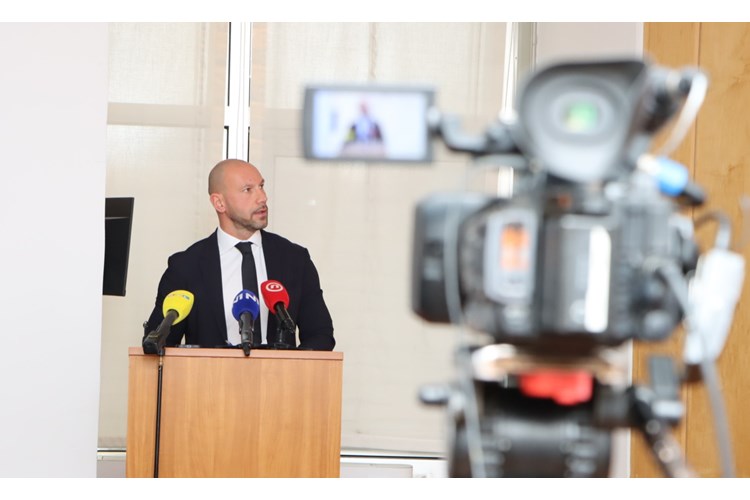
Minister of Justice, Public Administration and Digital Transformation Damir Habijan held a press conference where he presented proposals for amendments to the Civil Obligations Act, the Consumer Bankruptcy Act and the new Act on the Protection of Persons Who Engage in Public Participation
At the beginning of his presentation, the Minister pointed out multiple reasons for the changes to the legal framework. ‘On the one hand, this is our obligation as a Member State of the European Union to align Croatian legislation with the EU acquis, and on the other hand, it is about internal reasons - an analysis of the current situation and the need to further improve certain solutions’, he said.
The most comprehensive amendments concern the Civil Obligations Act, which transposes two European directives - the Directive on liability for defective products and the Directive on common rules promoting the repair of goods, which aim to encourage consumers to use products for a longer period and to reduce waste.
The Minister explained that in the current Act there was already an institute of liability for a defective product, but that technological development required its modernisation. ‘The 1985 Directive no longer fully responds to the challenges of the digital age. The new framework takes into account scientific and technological progress, but also the fact of the transition to a circular economy in the sense that the product becomes a new raw material after use and not waste’, he said.
From a consumer perspective, it is particularly important that the proposed amendments broaden the circle of responsible persons.
In addition to manufacturers, it will also be possible to claim damages from importers, manufacturers’ representatives, fulfilment service providers, suppliers and providers of online platforms. It also prescribes the existing limitation periods for initiating proceedings - a subjective period of three years from the date of becoming aware of the defectiveness of the product and an objective period of ten years from the date on which the product was placed on the market or put into service. Exceptionally, as a novelty, in the case of covert bodily injury, an objective period of 25 years applies for the right itself to cease.
In addition, the period of liability for material defects in the event of their removal by repairing the item is extended, as well as the fact that during the repair the seller will be able to provide or borrow a replacement item free of charge to the consumer.
Referring to the amendments to the Consumer Bankruptcy Act, the Minister recalled that this law had been adopted in 2015 and that the proceedings fell within the jurisdiction of municipal courts. The analysis of the situation had shown a continuous increase in the number of cases, which is why it was proposed to transfer jurisdiction to commercial courts, which specialised in bankruptcy proceedings.
Another law presented was the new Act on the Protection of Persons Who Engage in Public Participation, which transposes Directive (EU) 2024/1069 into Croatian law.
The aim of the Act is to protect journalists, publishers, media organisations, whistle-blowers, human rights defenders, civil society organisations, trade unions, artists, researchers, academics and others from unfounded and abusive court proceedings.
It was stressed that the new law meant a wider application of the Directive, i.e. that the Act would apply to all cases regardless of the existence of cross-border elements. The Judicial Academy would be designated as a single point of contact for access to information on available procedural guarantees, remedies and support measures, while the Ministry of Justice, Public Administration and Digital Transformation would keep records and statistics of court cases, to be provided annually to the European Commission. All three legislative proposals are about to be submitted for public consultation.
News