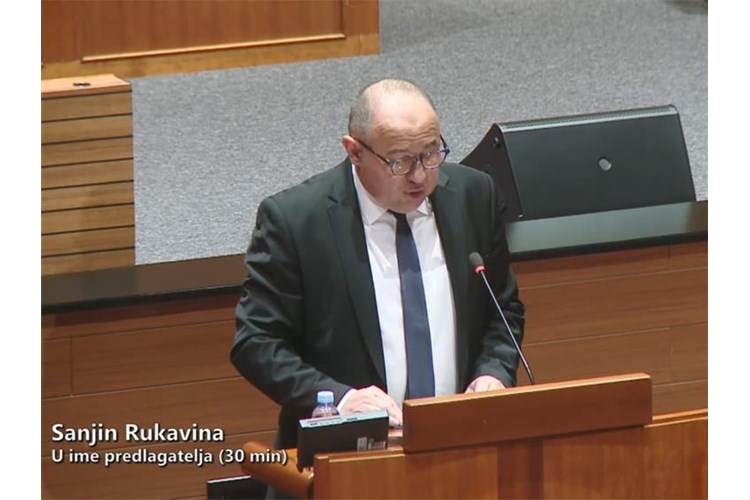
At the 8th session of the Croatian Parliament, State Secretary Sanjin Rukavina presented the Final Proposal of the Act on Cross-Border Gathering of Electronic Evidence in Criminal Proceedings
The Act will ensure the implementation of Regulation 2023/1543 on European Production Orders and Preservation Orders for electronic evidence in criminal proceedings and for the execution of custodial sentences following criminal proceedings.
At the beginning of his presentation, State Secretary Rukavina explained that the Act will also transpose into Croatian law Directive (EU) 2023/1544 laying down harmonised rules for the designation of designated establishments and for the appointment of legal representatives for the purpose of gathering electronic evidence in electronic procedures.
The aim is to facilitate and accelerate access by judicial authorities conducting criminal proceedings to electronic evidence used to investigate and prosecute criminal offences, irrespective of where the data are located and assuming that the holder of such data provides services within the territory of the European Union.
‘So far, this cooperation has been carried out with the mandatory intervention of the competent judicial authorities of the Member States, and these instruments provide that the judicial authorities of one Member State will obtain data directly from service providers in another Member State, who are under an obligation to designate in each State their designated establishments or legal representatives’, explained State Secretary Rukavina.
Under the Final Act Proposal, a judicial authority in one EU Member State may require a designated establishment of a service provider established in another Member State or its designated legal representative in another Member State to provide electronic evidence.
‘Furthermore, each Member State is obliged to set up a decentralised IT system through which competent authorities and addressees will communicate, and this draft law provides that the installation to maintain the national access point of the decentralised IT system will be provided by an operational technical body responsible for the supervision of telecommunications’, added State Secretary Rukavina.
The central authority that will ensure the application of this law is the Croatian Regulatory Authority for Network Industries (HAKOM), as it relates to the obligations of service providers, while the ministry responsible for justice will be the coordinating body that provides assistance to domestic authorities and authorities of other Member States in the implementation of judicial cooperation and compiling comprehensive statistical data for the purpose of reporting to the European Commission.
‘The Final Proposal incorporates all the comments of the Legislation Committee, which were of a nomotechnical nature, and provides that the provisions of the Final Proposal which serve to transpose the Directive will enter into force on 18 February 2026, while the Regulation and the provisions of the Final Proposal which relate to its implementation will apply from 18 August 2026’, he concluded.
News