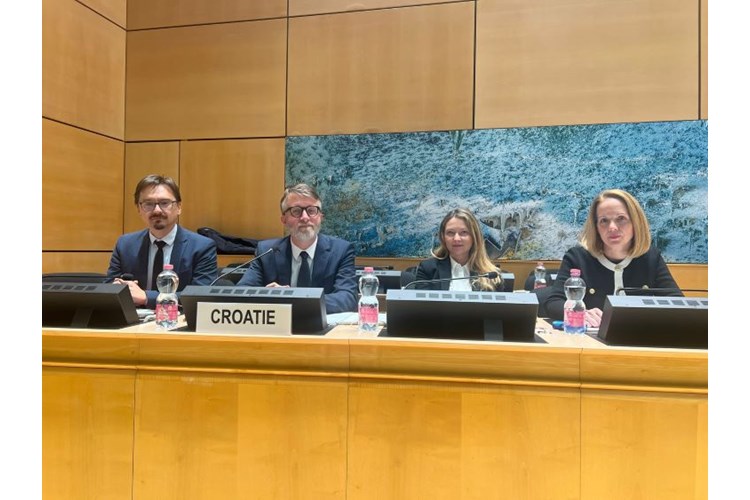
On 10 November 2025, at the United Nations Office at Geneva, the Republic of Croatia presented its Fourth Report within the framework of the Universal Periodic Review (UPR) of the United Nations Human Rights Council
The Croatian interdepartmental delegation was headed by State Secretary at the Ministry of Justice, Public Administration and Digital Transformation Ivan Crnčec, and comprised representatives of several ministries, including the Ministry of Foreign and European Affairs, which coordinated the preparation of the report.
The UPR is a regular UN mechanism under which all Member States provide an overview of the human rights situation at national level every five years.
During the dialogue with the member states, the delegation addressed issues and recommendations and highlighted Croatia's progress over the past period, including institutional strengthening, legislative changes and the protection of vulnerable groups. This is the fourth time Croatia defended its report, and the previous defence took place in 2020.
Croatia continues to implement reforms aimed at strengthening the rule of law, protecting human rights and increasing access to justice for all citizens.
The 2025 amendments to the Criminal Code transposed Directive (EU) 2024/1712 on combating trafficking in human beings and protecting its victims. The new rules extend criminal protection by introducing new forms of crime, stricter penalties and specific measures to protect victims.
In the area of media freedom, it was further confirmed that journalists cannot be held criminally liable for reporting in the public interest, thus ensuring free and responsible journalism and the protection of sources of information.
Significant resources have also been invested in the free legal aid system, and the planned amendments to the law will further facilitate and speed up access to legal aid, especially for citizens in rural and earthquake-affected areas.
Regarding hate speech and hate crime, it was pointed out that Croatia strongly condemns all forms of hate speech and hate crime and that the competent authorities react promptly to their occurrence. It was emphasized that the criminal offence of public incitement to violence and hatred criminalised public incitement to violence and hatred directed against specific groups of people on different discriminatory grounds covered by the definition of the crime.
It was also pointed out that those discriminatory grounds not only meet the requirements set by the European Union Framework Decision 2008/913/JHA of 28 November 2008 on combating certain forms and expressions of racism and xenophobia, but also cover a wider range of discriminatory grounds than those that Member States are obliged to implement in accordance with the acquis communautaire.
In the prison system, measures have been implemented to reduce overcrowding and improve the healthcare of prisoners, while compliance with international standards is being ensured through the construction of new accommodation capacities and the development of alternative forms of pretrial detention.
When it comes to combating violence against women and domestic violence, a definition of gender-based violence and a new criminal offence of aggravated murder of a female person were introduced, and the legal framework was strengthened with faster and more effective victim protection procedures.
Special attention is focused on the protection of children - the Barnahus project is being implemented to establish the first national Children's House, modelled on the European model, to support child victims of crime in a safe and child-friendly environment.
The last part of the Universal Periodic Review was dedicated to the prosecution of war crimes. Croatia remains committed to fighting impunity for war crimes and strengthening regional cooperation in their prosecution, while at the same time advocating truth, justice and respect for victims.
With this, the Republic of Croatia reaffirmed its commitment to the promotion of human rights, gender equality and cooperation with international mechanisms, as well as its openness to constructive dialogue and continuous improvement of national policies.
News